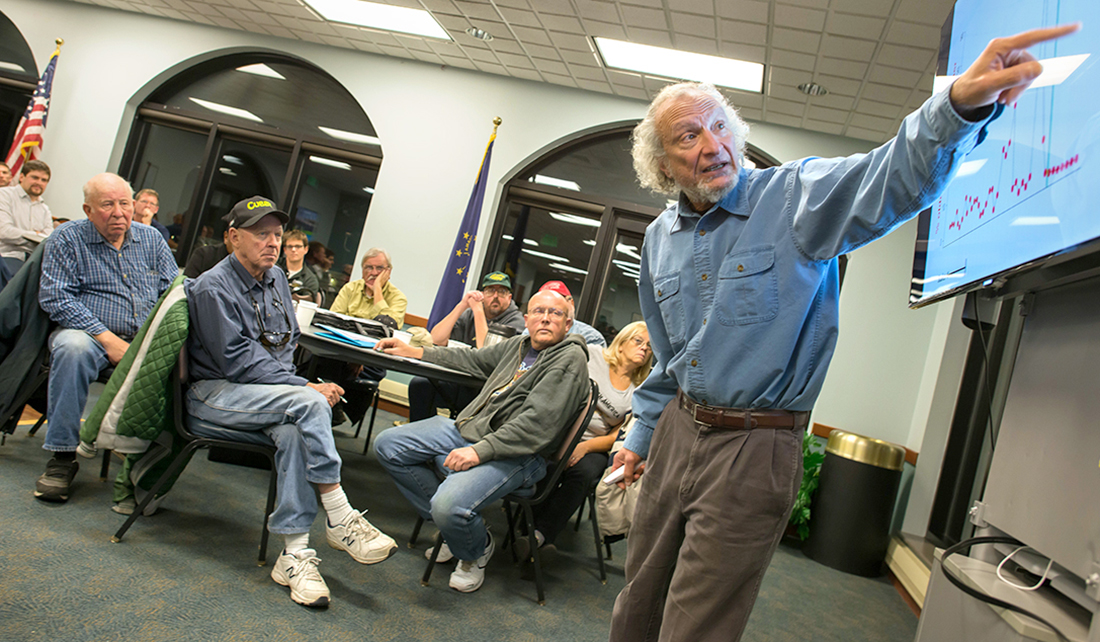
The first of hopefully many recreational fishing workshops brought together more than 40 researchers, managers, stakeholders, and anglers last week to Hammond Marina in Indiana to learn about food web research, updates on fisheries, and ongoing monitoring in southern Lake Michigan.
Mitchell Zischke, IISG research and extension fishery specialist, organized the event.
“I have presented research at similar workshops for Lake Huron hosted by Michigan Sea Grant. These workshops were well attended and a great opportunity for anglers, scientists, managers, and others to interact,” said Zischke. “I wanted to develop a similar program for southern Lake Michigan, particularly in light of recent ecosystem and fishery changes like the declining populations of alewife.”
The five speakers hailed from NOAA Great Lakes Environmental Research Laboratory, U.S. Geological Survey Great Lakes Science Center, U.S. Fish and Wildlife, Ball State University, and Illinois Natural History Survey.
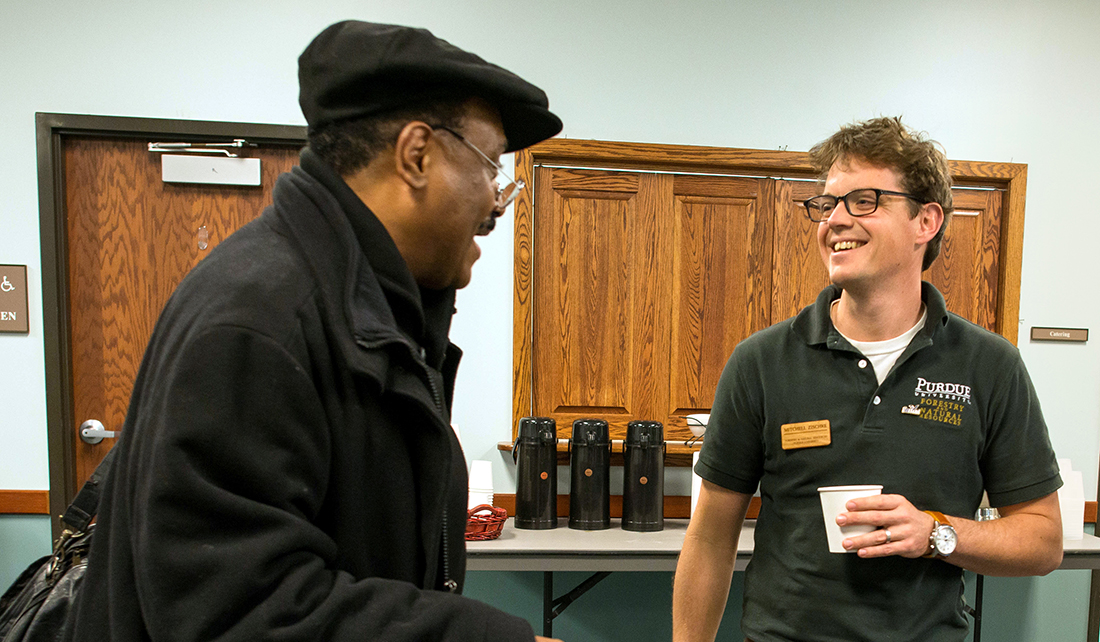
Mitchell Zischke, IISG research and extension fishery specialist, pictured on the right, organized the event.
Topics included recent changes in the base of the food web, status and trends of prey fish, mass-marking of Chinook salmon and lake trout, long-term monitoring of yellow perch, and angler surveys and the recreational fishery focusing on the Illinois waters of Lake Michigan.
Howard Petroski, known as “Captain Ski,” ran Paradise Charters out of East Chicago for 25 years until it shut down about 14 years ago. Even though he now just fishes recreationally, he still follows what’s happening in Lake Michigan.
“What they’re showing with the decline of the perch was pretty obvious, but now it’s more obvious that they showed it on the charts,” Petroski said.
According to Zischke, this first workshop just scratched the surface on topics relevant to anglers in southern Lake Michigan.
“There were actually more people willing to present than I could fit in the workshop agenda. We hope that these workshops can become an annual event in both Indiana and Illinois, that way we can continue to provide anglers and other lake-users with up-to-date information on the Lake Michigan fishery and ecosystem as a whole. In fact, attendees at our recent workshop said that they can’t wait for the next one!”
Illinois-Indiana Sea Grant is a part of University of Illinois Extension and Purdue Extension.