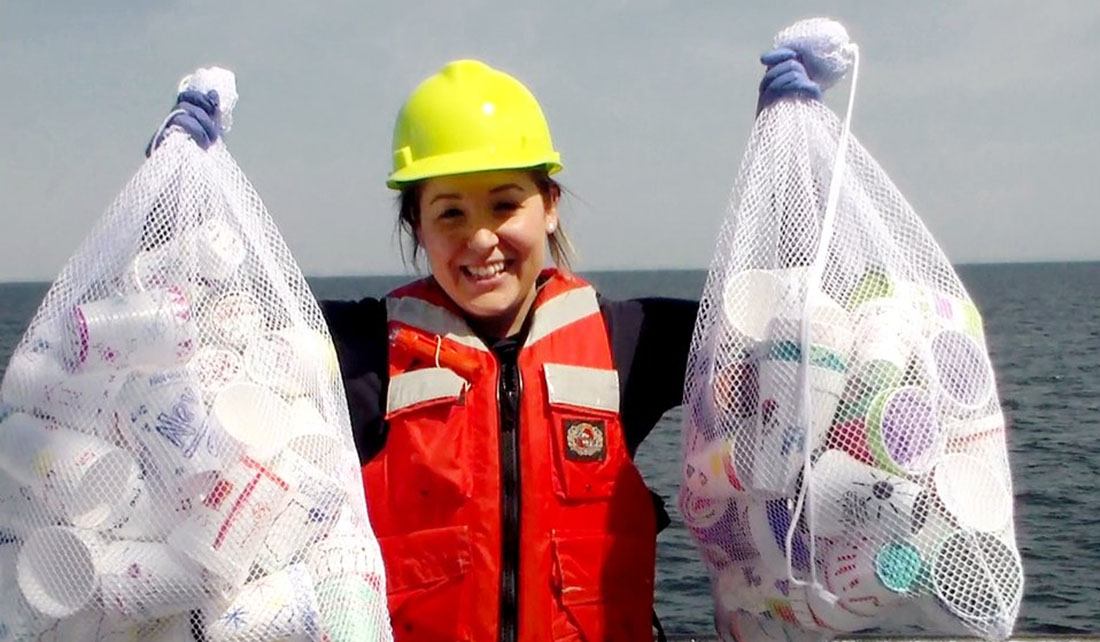
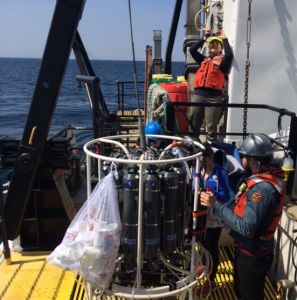
U.S. EPA’s Research Vessel Lake Guardian graces our page once again for this year’s annual Shipboard Science Workshop. “This workshop allows educators to work on a research project with a Great Lakes scientist for the week they are on the ship,” said IISG Educator Allison Neubauer. “They use equipment to collect samples from the lake, analyze them in the labs onboard the ship, and come up with answers to the questions of their particular research project.”
Past workshops have included collecting data on plankton communities, plastic pollution, and overall water quality of the Great Lakes. This season, educators aboard the R/V Lake Guardian will have the opportunity to participate in what is known as The Incredible Shrinking Cup Lab, coordinated by Kristin TePas, IISG’s community outreach specialist.
The principle guiding The Incredible Shrinking Cup Lab is called Boyle’s law, which, when simplified, says that the volume of a gas is inversely proportional to the pressure being exerted upon it. We see this with weather balloons, which, when they’re launched, can range from 2.5 ft. to 8 ft. in diameter, but expand more than four times in diameter during flight, becoming as large as 32 ft. wide. As a balloon gains altitude, less pressure is being exerted on it from the outside, allowing the gas inside to expand until, ultimately, the balloon pops.
The Incredible Shrinking Cup Lab takes things in the opposite direction, observing the effects of increased pressure as Styrofoam cups are sunk hundreds of feet underneath the water. Gas pockets inside the Styrofoam cups shrink as the distance below sea level, and subsequent pressure, increases, compressing the cup’s structure, making it smaller.
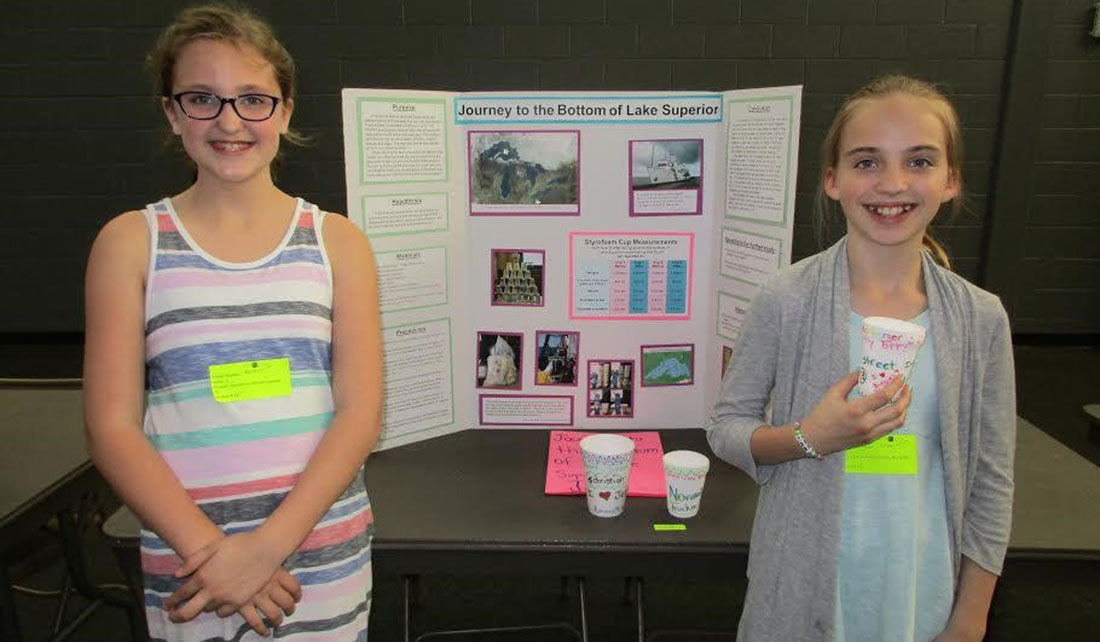
Two students of Marcy Burns, Main Street Intermediate School in Norwalk, Ohio, pose after winning third place in the OhioView SATELLITES Conference and research project fair at the University of Toledo.
This activity provides students the opportunity to see the effects of Boyle’s law first hand. Before the cups are submerged, students are taught how to measure their volume, density, and mass. They personalize their cups to know whose is whose, craft hypotheses on what will happen to the cups, and are put into direct contact with research scientists, who do the submerging themselves once at their stations in the ocean or in the Great Lakes. Allison Neubauer was able to document two rounds of sending down cups this past April while aboard the R/V Lake Guardian in Lake Superior.
Illinois-Indiana Sea Grant is a part of University of Illinois Extension and Purdue Extension.